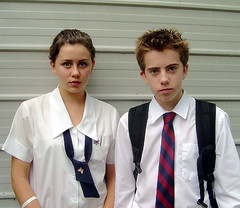

Originally uploaded by RaeA.
“Youth is a wonderful thing. What a crime to waste it on children.”
– George Bernard Shaw
Originally uploaded by RaeA.
“Youth is a wonderful thing. What a crime to waste it on children.”
– George Bernard Shaw
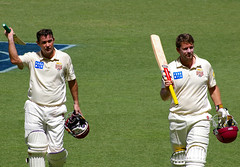
Originally uploaded by RaeA.
A peaceful spot is Pipers Flat. The fold that live around
They keep themselves by keeping sheep and turning up the ground
But the climate is erratic and the consequences are
The struggle with the elements is everlasting war
We plough and sow and harrow, then sit and pray for rain
And then we all get flooded out and have to start again
But the folk are now rejoicing as they ne’er rejoiced before
For we’ve played Molongo at cricket and McDougal topped the score
Molongo had a head on it and challenged us to play
A single innings match for lunch, the losing team to pay
We were not great guns at cricket, but we couldn’t well say no
So we all began to practise and we let the reaping go
We scoured the Flat for ten miles round to muster up our men
But when the list was totaled we could only number ten
Then up spoke big Tim Brady, he was always slow to speak
And he said, “What price McDougal who lives down at Coopers Creek?”
So we sent for old McDougal and he stated in reply
That he’d never played at cricket, but he’d half a mind to try
He couldn’t come to practice – he was getting in his hay
But he guessed he’d show the beggars from Molongo how to play
Now, McDougal was a Scotchman, and a canny one at that
So he started in to practise with a paling for a bat
He got Mrs Mac to bowl to him, but she couldn’t run at all
So he trained his sheep dog Pincher how to scout and fetch the ball
Now, Pincher was no puppy, he was old and worn and grey
But he understood McDougal, and – accustomed to obey
When McDougal cried out “Fetch it!” he would fetch it in a trice
But, until the word was “Drop it!” he would grip it like a vice
And each succeeding night they played until the light grew dim
Sometimes McDougal struck the ball – sometimes the ball struck him
Each time he struck the ball would plough a furrow in the ground
And when he missed the impetus would turn him three times round
The fatal day at last arrived – the day that was to see
Molongo bite the dust or Pipers Flat knocked up a tree
Molongo’s captain won the toss and sent his men to bat
And they gave some leather hunting to the men of Pipers Flat
When the ball sped where McDougal stood, firm planted in his track
He shut his eyes and turned him round and stopped it with his back!
The highest score was twenty two, the total sixty six
When Brady sent a Yorker down that scattered Johnson’s sticks
The Pipers Flat went in to bat, for glory and renown
But, like the grass before the scythe, our wickets tumbled down
Nine wickets down for seventeen with fifty more to win
Our captain heaved a sigh, and sent McDougal in
“Ten pounds to one you’ll lose it!” cried a barracker from the town
But McDougal said, “I’ll take it mon!” and planted the money down
Then he girded up his moleskins in a self reliant style
Threw off his hat and boots and faced the bowler with a smile
He held the bat the wrong side out and Johnson with a grin
Stepped lightly to the bowling crease and sent a “wobbler” in
McDougal spponed it softly back and Johnson waited there
But McDougal crying “Fetch it!” started running like a hare
Molongo shouted “Victory!” He’s out as sure as eggs
When Pincher started throught the crowd and ran through Johnson’s legs
He seized the ball like lightening then he ran behind a log
And McDougal kept on running while Molongo chased the dog!
They chased him up, they chased him down, they chased him round and then
He darted through the slip-rail as the scorer shouted, “Ten!”
McDougal puffed, Molongo swore, excitement was intense
As the scorer marked down twenty, Pincher cleared a barbed wire fence
“Let us head him!” shrieked Molongo, “Brain the mongrel with a bat!”
“Run it out! Good old McDougal!” yelled the men from Pipers Flat
And McDougal kept on jogging and then Pincher doubled back
And the scorter counted “Forty” as they raced across the track
McDougal’s legs were going fast, Molongo’s breath was gone
But still Molongo chased the dog – McDougal struggled on
When the scorer shouted “Fifty!”, then they knew the chase would cease
And McDougal gasged out “Drop it!” as he dropped within his crease
Then Pincher dropped the ball and as instinctively he knew
Discretion was the wiser plan, he disappeared from view
And as Molongo’s beaten men exhausted lay around
We raised McDougal shoulder high and bore him from the ground
We bore him to McGinnis’s where lunch was ready laid
And filled him up with whisky punch for which Molongo paid
We drank his health in bumpers and we cheered him three times three
And when Molongo got its breath Molongo joined the spree
And the critics say they never saw a cricket match like that
When McDougal broke the record in the game at Pipers Flat
And the folk are jubilating as they never did before
For we played Molongo cricket and McDougal topped the score!
Thomas E. Spencer
When one goes to Obaku temple in Kyoto he sees carved over the gate the words “The First Principle”. The letters are unusually large, and those who appreciate calligraphy always admire them as being a mastepiece. They were drawn by Kosen two hundred years ago.
When the master drew them he did so on paper, from which the workmen made the large carving in wood. As Kosen sketched the letters a bold pupil was with him who had made several gallons of ink for the calligraphy and who never failed to criticise his master’s work.
“That is not good,” he told Kosen after his first effort.
“How is this one?”
“Poor. Worse than before,” pronounced the pupil.
Kosen patiently wrote one sheet after another until eighty-four First Principles had accumulated, still without the approval of the pupil.
Then when the young man stepped outside for a few moments, Kosen thought: “Now this is my chance to escape his keen eye,” and he wrote hurriedly, with a mind free from distraction: “The First Principle.”
“A masterpiece,” pronounced the pupil.
All is over! fleet career,
Dash of greyhound slipping thongs,
Flight of falcon, bound of deer,
Mad hoof-thunder in our rear,
Cold air rushing up our lungs,
Din of many tongues.
Once again, one struggle good,
One vain effort; — he must dwell
Near the shifted post, that stood
Where the splinters of the wood,
Lying in the torn tracks, tell
How he struck and fell.
Crest where cold drops beaded cling,
Small ear drooping, nostril full,
Glazing to a scarlet ring,
Flanks and haunches quivering,
Sinews stiff’ning, void and null,
Dumb eyes sorrowful.
Satin coat that seems to shine
Duller now, black braided tress,
That a softer hand than mine
Far away was wont to twine,
That in meadows far from this
Softer lips might kiss.
All is over! this is death,
And I stand to watch thee die,
Brave old horse! with ‘bated breath
Hardly drawn through tight-clenched teeth,
Lip indented deep, but eye
Only dull and dry.
Musing on the husk and chaff
Gather’d where life’s tares are sown,
Thus I speak, and force a laugh
That is half a sneer and half
An involuntary groan,
In a stifled tone —
“Rest, old friend! thy day, though rife
With its toil, hath ended soon;
We have had our share of strife,
Tumblers in the mask of life,
In the pantomime of noon
Clown and pantaloon.
“With the flash that ends thy pain
Respite and oblivion blest
Come to greet thee. I in vain
Fall: I rise to fall again:
Thou hast fallen to thy rest —
And thy fall is best!”
– Adam Lindsay Gordon
Two households, both alike in dignity,
In fair Verona, where we lay our scene,
From ancient grudge break to new mutiny,
Where civil blood makes civil hands unclean.
From forth the fatal loins of these two foes
A pair of star-cross’d lovers take their life;
Whole misadventured piteous overthrows
Do with their death bury their parents’ strife.
The fearful passage of their death-mark’d love,
And the continuance of their parents’ rage,
Which, but their children’s end, nought could remove,
Is now the two hours’ traffic of our stage;
The which if you with patient ears attend,
What here shall miss, our toil shall strive to mend.
“Just because your voice reaches halfway around the world doesn’t mean you are wiser than when it reached only to the end of the bar.” – Edward R. Murrow
Sometimes the mind is still.
There is no anxiety, and the heart is clear throughout.
Then it is said that even though the body is in the human realm, the mind roams in heaven.Â
However in one day an ordinary person transmigrates countless times, during which he rarely keeps the human mind, much less roams in heaven.
– Master Torei (1721-1792)
There are different kinds of terrain in nature. Some terrain is easily accessible, some is entrapping, some temporizing, some constricted, some precipitous and some distant.What terrain is accessible? Ground that is easy for both your troops and the enemy’s to move across is called accessible terrain. If you enter the accessible region, you should first take high and sunny positions and keep your supply routes unimpeded. This is convenient for you to fight with the enemy.
– Sun Tzu
I always like to make a beef stew during winter. Its a great solid warmer and the left-overs are great for lunch.
Ingredients:
500g chuck or topside beef
tablespoon olive oil
1/2 brown onion
2 large carrots
1/2 litre good stock
3 large washed potatoes
handful diced pumpkin
400g Borlotti Beans
cupful of cauliflower chopped.
Recipe:
Cube the beef into 1-2cm cubes. I prefer them larger but my family likes them smaller.
In a large saucepan add a tablespoon of olive oil.
Add the cubed beef and cook until sealed. Add the onion in large chunks and let it caramelise during the process.
Add the stock so it covers the beef, bring it to the boil, and then turn it down to simmer.
Add one potatoe. I prefer to leave the skins on as this helps to stop the potatoe turning into starch.
Add the carrots cut into decent sized pieces.
Cook for 2 hours on simmer, then add the other carrot, and the rest of the potatoe.
Cook for half an hour then add the pumpkin
Cook for half an hour then add the borlotti’s and the cauliflower.
Cook for half an hour on simmer then turn off.
The early potato will thicken the sauce, while the latter additions maintain their integrity. If you cutt the meat too small it will almost have disappeared by this stage.
