• Andy’s Gone With Cattle

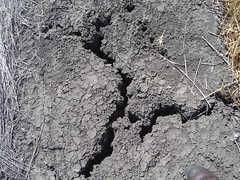
    DSC01376 - Black soil

    Our Andy’s gone to battle now
    ‘Gainst Drought, the red marauder;
    Our Andy’s gone with cattle now
    Across the Queensland border.

    He’s left us in dejection now;
    Our hearts with him are roving.
    It’s dull on this selection now,
    Since Andy went a-droving.

    Who now shall wear the cheerful face
    In times when things are slackest?
    And who shall whistle round the place
    When Fortune frowns her blackest?

    Oh, who shall cheek the squatter now
    When he comes round us snarling?
    His tongue is growing hotter now
    Since Andy cross’d the Darling.

    The gates are out of order now,
    In storms the “riders” rattle;
    For far across the border now
    Our Andy’s gone with cattle.

    Poor Aunty’s looking thin and white;
    And Uncle’s cross with worry;
    And poor old Blucher howls all night
    Since Andy left Macquarie.

    Oh, may the showers in torrents fall,
    And all the tanks run over;
    And may the grass grow green and tall
    In pathways of the drover;

    And may good angels send the rain
    On desert stretches sandy;
    And when the summer comes again
    God grant ’twill bring us Andy.

    – Henry Lawson (1888 )

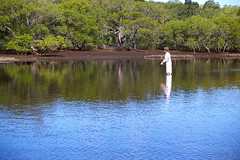
  • Step in the river

    No man ever steps in the same river twice, for it’s not the same river and he’s not the same man.

    Heraclitus – (c.535 – 475 BC)

  • you in reality


    Give up all questions except one: “Who am I?”

    After all, the only fact you are sure of is that you are.

    The “I am” is certain. The “I am this” is not.

    Struggle to find out what you are in reality.

    – Sri Nisargadatta Maharaj

  • Five Bells

    Time that is moved by little fidget wheels
    Is not my time, the flood that does not flow.
    Between the double and the single bell
    Of a ship’s hour, between a round of bells
    From the dark warship riding there below,
    I have lived many lives, and this one life
    Of Joe, long dead, who lives between five bells.

    Deep and dissolving verticals of light
    Ferry the falls of moonshine down. Five bells
    Coldly rung out in a machine’s voice. Night and water
    Pour to one rip of darkness, the Harbour floats
    In the air, the Cross hangs upside-down in water.

    Why do I think of you, dead man, why thieve
    These profitless lodgings from the flukes of thought
    Anchored in Time? You have gone from earth,
    Gone even from the meaning of a name;
    Yet something’s there, yet something forms its lips
    And hits and cries against the ports of space,
    Beating their sides to make its fury heard.

    Are you shouting at me, dead man, squeezing your face
    In agonies of speech on speechless panes?
    Cry louder, beat the windows, bawl your name!

    But I hear nothing, nothing…only bells,
    Five bells, the bumpkin calculus of Time.
    Your echoes die, your voice is dowsed by Life,
    There’s not a mouth can fly the pygmy strait –
    Nothing except the memory of some bones
    Long shoved away, and sucked away, in mud;
    And unimportant things you might have done,
    Or once I thought you did; but you forgot,
    And all have now forgotten – looks and words
    And slops of beer; your coat with buttons off,
    Your gaunt chin and pricked eye, and raging tales
    Of Irish kings and English perfidy,
    And dirtier perfidy of publicans
    Groaning to God from Darlinghurst.
    Five bells.

    Then I saw the road, I heard the thunder
    Tumble, and felt the talons of the rain
    The night we came to Moorebank in slab-dark,
    So dark you bore no body, had no face,
    But a sheer voice that rattled out of air
    (As now you’d cry if I could break the glass),
    A voice that spoke beside me in the bush,
    Loud for a breath or bitten off by wind,
    Of Milton, melons, and the Rights of Man,
    And blowing flutes, and how Tahitian girls
    Are brown and angry-tongued, and Sydney girls
    Are white and angry-tongued, or so you’d found.
    But all I heard was words that didn’t join
    So Milton became melons, melons girls,
    And fifty mouths, it seemed, were out that night,
    And in each tree an Ear was bending down,
    Or something that had just run, gone behind the grass,
    When blank and bone-white, like a maniac’s thought,
    The naphtha-flash of lightning slit the sky,
    Knifing the dark with deathly photographs.
    There’s not so many with so poor a purse
    Or fierce a need, must fare by night like that,
    Five miles in darkness on a country track,
    But when you do, that’s what you think.
    Five bells.

    In Melbourne, your appetite had gone,
    Your angers too; they had been leeched away
    By the soft archery of summer rains
    And the sponge-paws of wetness, the slow damp
    That stuck the leaves of living, snailed the mind,
    And showed your bones, that had been sharp with rage,
    The sodden ectasies of rectitude.
    I thought of what you’d written in faint ink,
    Your journal with the sawn-off lock, that stayed behind
    With other things you left, all without use,
    All without meaning now, except a sign
    That someone had been living who now was dead:
    “At Labassa. Room 6 x 8
    On top of the tower; because of this, very dark
    And cold in winter. Everything has been stowed
    Into this room – 500 books all shapes
    And colours, dealt across the floor
    And over sills and on the laps of chairs;
    Guns, photoes of many differant things
    And differant curioes that I obtained…”

    In Sydney, by the spent aquarium-flare
    Of penny gaslight on pink wallpaper,
    We argued about blowing up the world,
    But you were living backward, so each night
    You crept a moment closer to the breast,
    And they were living, all of them, those frames
    And shapes of flesh that had perplexed your youth,
    And most your father, the old man gone blind,
    With fingers always round a fiddle’s neck,
    That graveyard mason whose fair monuments
    And tablets cut with dreams of piety
    Rest on the bosoms of a thousand men
    Staked bone by bone, in quiet astonishment
    At cargoes they had never thought to bear,
    These funeral-cakes of sweet and sculptured stone.

    Where have you gone? The tide is over you,
    The turn of midnight water’s over you,
    As Time is over you, and mystery,
    And memory, the flood that does not flow.
    You have no suburb, like those easier dead
    In private berths of dissolution laid –
    The tide goes over, the waves ride over you
    And let their shadows down like shining hair,
    But they are Water; and the sea-pinks bend
    Like lilies in your teeth, but they are Weed;
    And you are only part of an Idea.
    I felt the wet push its black thumb-balls in,
    The night you died, I felt your eardrums crack,
    And the short agony, the longer dream,
    The Nothing that was neither long nor short;
    But I was bound, and could not go that way,
    But I was blind, and could not feel your hand.
    If I could find an answer, could only find
    Your meaning, or could say why you were here
    Who now are gone, what purpose gave you breath
    Or seized it back, might I not hear your voice?

    I looked out my window in the dark
    At waves with diamond quills and combs of light
    That arched their mackerel-backs and smacked the sand
    In the moon’s drench, that straight enormous glaze,
    And ships far off asleep, and Harbour-buoys
    Tossing their fireballs wearily each to each,
    And tried to hear your voice, but all I heard
    Was a boat’s whistle, and the scraping squeal
    Of seabirds’ voices far away, and bells,
    Five bells. Five bells coldly ringing out.
    Five bells.

    – Kenneth Slessor

  • My Country by Dorothea Mackellar

    The love of field and coppice
    Of green and shaded lanes
    Of ordered woods and gardens
    Is running through your veins
    Strong love of grey-blue distance
    Brown streams and soft dim skies
    I know, but cannot share it
    My love is otherwise

    I love a sunburnt country
    A land of sweeping plains
    Of ragged mountain ranges
    Of droughts and flooding rains
    I love her far horizons
    I love her jewel sea
    Her beauty and her terror
    The wide brown land for me

    The stark white ring barked forests
    All tragic to the moon
    The sapphire misted mountains
    The hot gold hush of noon
    Green tangle of the brushes
    Where lithe lianas coil
    And orchids deck the tree tops
    And ferns the warm dark soil

    Core of my heart, my country
    Her pitiless blue sky
    When sick at heart around us
    We see the cattle die
    But then the grey clouds gather
    And we can bless again
    The drumming of the army
    The steady soaking rain

    Core of my heart, my country
    Land of the rainbow gold
    For flood and fire and famine
    She pays us back threefold
    Over the thirsty paddocks
    Watch, after many days
    The filmy veil of greenness
    That thickens as we gaze

    An opal hearted country
    A wilful, lavish land
    All you who have not loved her
    You will not understand
    Though earth holds many splendours
    Wherever I may die
    I know to what brown country
    My homing thoughts will fly.

    – Dorothea Mackellar

  • The Ballad of East and West

    Oh, East is East, and West is West, and never the twain shall meet,
    Till Earth and Sky stand presently at God’s great Judgment Seat;
    But there is neither East nor West, Border, nor Breed, nor Birth,
    When two strong men stand face to face, tho’ they come from the ends of the earth!

    Kamal is out with twenty men to raise the Border side,
    And he has lifted the Colonel’s mare that is the Colonel’s pride:
    He has lifted her out of the stable-door between the dawn and the day,
    And turned the calkins upon her feet, and ridden her far away.

    Then up and spoke the Colonel’s son that led a troop of the Guides:
    “Is there never a man of all my men can say where Kamal hides?”
    Then up and spoke Mahommed Khan, the son of the Ressaldar,
    “If ye know the track of the morning-mist, ye know where his pickets are.
    At dusk he harries the Abazai-at dawn he is into Bonair,
    But he must go by Fort Bukloh to his own place to fare,
    So if ye gallop to Fort Bukloh as fast as a bird can fly,
    By the favor of God ye may cut him off ere he win to the Tongue of Jagai,
    But if he be passed the Tongue of Jagai, right swiftly turn ye then,
    For the length and the breadth of that grisly plain is sown with Kamal’s men.
    There is rock to the left, and rock to the right, and low lean thorn between,
    And ye may hear a breech-bolt snick where never a man is seen.”

    The Colonel’s son has taken a horse, and a raw rough dun was he,
    With the mouth of a bell and the heart of Hell, and the head of the gallows-tree.
    The Colonel’s son to the Fort has won, they bid him stay to eat-
    Who rides at the tail of a Border thief, he sits not long at his meat.

    He ‘s up and away from Fort Bukloh as fast as he can fly,
    Till he was aware of his father’s mare in the gut of the Tongue of Jagai,
    Till he was aware of his father’s mare with Kamal upon her back,
    And when he could spy the white of her eye, he made the pistol crack.
    He has fired once, he has fired twice, but the whistling ball went wide.
    “Ye shoot like a soldier,” Kamal said. “Show now if ye can ride.”

    It ‘s up and over the Tongue of Jagai, as blown dust-devils go,
    The dun he fled like a stag of ten, but the mare like a barren doe.
    The dun he leaned against the bit and slugged his head above,
    But the red mare played with the snaffle-bars, as a maiden plays with a glove.
    There was rock to the left and rock to the right, and low lean thorn between,
    And thrice he heard a breech-bolt snick tho’ never a man was seen.

    They have ridden the low moon out of the sky, their hoofs drum up the dawn,
    The dun he went like a wounded bull, but the mare like a new-roused fawn.
    The dun he fell at a water-course-in a woful heap fell he,
    And Kamal has turned the red mare back, and pulled the rider free.

    He has knocked the pistol out of his hand-small room was there to strive,
    “‘T was only by favor of mine,” quoth he, “ye rode so long alive:
    There was not a rock for twenty mile, there was not a clump of tree,
    But covered a man of my own men with his rifle cocked on his knee.
    If I had raised my bridle-hand, as I have held it low,
    The little jackals that flee so fast, were feasting all in a row:
    If I had bowed my head on my breast, as I have held it high,
    The kite that whistles above us now were gorged till she could not fly.”

    Lightly answered the Colonel’s son:-“Do good to bird and beast,
    But count who come for the broken meats before thou makest a feast.
    If there should follow a thousand swords to carry my bones away,
    Belike the price of a jackal’s meal were more than a thief could pay.
    They will feed their horse on the standing crop, their men on the garnered grain,
    The thatch of the byres will serve their fires when all the cattle are slain.
    But if thou thinkest the price be fair,-thy brethren wait to sup,
    The hound is kin to the jackal-spawn,-howl, dog, and call them up!
    And if thou thinkest the price be high, in steer and gear and stack,
    Give me my father’s mare again, and I ‘ll fight my own way back!”

    Kamal has gripped him by the hand and set him upon his feet.
    “No talk shall be of dogs,” said he, “when wolf and gray wolf meet.
    May I eat dirt if thou hast hurt of me in deed or breath;
    What dam of lances brought thee forth to jest at the dawn with Death?”
    Lightly answered the Colonel’s son: “I hold by the blood of my clan:
    Take up the mare for my father’s gift-by God, she has carried a man!”

    The red mare ran to the Colonel’s son, and nuzzled against his breast,
    “We be two strong men,” said Kamal then, “but she loveth the younger best.
    So she shall go with a lifter’s dower, my turquoise-studded rein,
    My broidered saddle and saddle-cloth, and silver stirrups twain.”

    The Colonel’s son a pistol drew and held it muzzle-end,
    “Ye have taken the one from a foe,” said he; “will ye take the mate from a friend?”
    “A gift for a gift,” said Kamal straight; “a limb for the risk of a limb.
    Thy father has sent his son to me, I ‘ll send my son to him!”

    With that he whistled his only son, that dropped from a mountain-crest-
    He trod the ling like a buck in spring, and he looked like a lance in rest.
    “Now here is thy master,” Kamal said, “who leads a troop of the Guides,
    And thou must ride at his left side as shield on shoulder rides.
    Till Death or I cut loose the tie, at camp and board and bed,
    Thy life is his-thy fate it is to guard him with thy head.
    So thou must eat the White Queen’s meat, and all her foes are thine,
    And thou must harry thy father’s hold for the peace of the border-line.
    And thou must make a trooper tough and hack thy way to power-
    Belike they will raise thee to Ressaldar when I am hanged in Peshawur.”

    They have looked each other between the eyes, and there they found no fault,
    They have taken the Oath of the Brother-in-Blood on leavened bread and salt:
    They have taken the Oath of the Brother-in-Blood on fire and fresh-cut sod,
    On the hilt and the haft of the Khyber knife, and the Wondrous Names of God.
    The Colonel’s son he rides the mare and Kamal’s boy the dun,
    And two have come back to Fort Bukloh where there went forth but one.
    And when they drew to the Quarter-Guard, full twenty swords flew clear-
    There was not a man but carried his feud with the blood of the mountaineer.
    “Ha’ done! ha’ done!” said the Colonel’s son. “Put up the steel at your sides!
    Last night ye had struck at a Border thief-to-night ‘t is a man of the Guides!”

    Oh, East is East, and West is West, and never the two shall meet,
    Till Earth and Sky stand presently at God’s great Judgment Seat;
    But there is neither East nor West, Border, nor Breed, nor Birth,
    When two strong men stand face to face, tho’ they come from the ends of the earth

    – Rudyard Kipling (1865-1936)
  • A Bush Christening – A.B. Paterson

    On the outer Barcoo where the churches are few,
    And men of religion are scanty,
    On a road never cross’d ‘cept by folk that are lost,
    One Michael Magee had a shanty.

    Now this Mike was the dad of a ten year old lad,
    Plump, healthy, and stoutly conditioned;
    He was strong as the best, but poor Mike had no rest
    For the youngster had never been christened.

    And his wife used to cry, “If the darlin’ should die
    Saint Peter would not recognise him.”
    But by luck he survived till a preacher arrived,
    Who agreed straightaway to baptise him.

    Now the artful young rogue, while they held their collogue,
    With his ear to the keyhole was listenin’,
    And he muttered in fright, while his features turned white,
    “What the divil and all is this christenin’?”

    He was none of your dolts, he had seen them brand colts,
    And it seemed to his small understanding,
    If the man in the frock made him one of the flock,
    It must mean something very like branding.

    So away with a rush he set off for the bush,
    While the tears in his eyelids they glistened
    “Tis outrageous,” says he, “to brand youngsters like me,
    I’ll be dashed if I’ll stop to be christened!”

    Like a young native dog he ran into a log,
    And his father with language uncivil,
    Never heeding the `praste’ cried aloud in his haste,
    “Come out and be christened, you divil!”

    But he lay there as snug as a bug in a rug,
    And his parents in vain might reprove him,
    Till his reverence spoke (he was fond of a joke)
    “I’ve a notion,” says he, “that’ll move him.”

    “Poke a stick up the log, give the spalpeen a prog;
    Poke him aisy — don’t hurt him or maim him,
    “Tis not long that he’ll stand, I’ve the water at hand,
    As he rushes out this end I’ll name him.

    “Here he comes, and for shame! ye’ve forgotten the name
    Is it Patsy or Michael or Dinnis?”
    Here the youngster ran out, and the priest gave a shout
    “Take your chance, anyhow, wid “Maginnis”‘!”

    As the howling young cub ran away to the scrub
    Where he knew that pursuit would be risky,
    The priest, as he fled, flung a flask at his head
    That was labelled “Maginnis’s Whisky”!

    And Maginnis Magee has been made a J.P.,
    And the one thing he hates more than sin is
    To be asked by the folk, who have heard of the joke,
    How he came to be christened “Maginnis”!

    A.B. Paterson

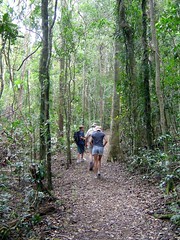
  • the great path


    Bushwalking in Lamington National Park

    The great path is clearly before your eyes,
    But the ignorant who are deluded
    And confused cannot recognize it.
    It is in one thought of the mind.
    So why search for it elsewhere?

    – Pao-chih

  • Grant McLennan of the go-betweens dies


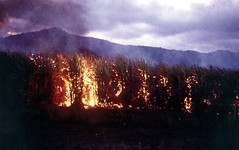
    cane_fire_gordonvale
    Originally uploaded by RaeA.

    Grant McLennan was one of the great Aussie songwriters. I went off to university in 1974, a 1600 km train trip down the Queensland coast, and made the same trip up and back each year. As a result his song Cattle and Cane rang particular bells.

    I recall a schoolboy coming home
    through fields of cane
    to a house of tin and timber
    and in the sky
    a rain of falling cinders
    from time to time
    the waste memory-wastes
    I recall a boy in bigger pants
    like everyone
    just waiting for a chance
    his father’s watch
    he left it in the showers
    from time to time
    the waste memory-wastes
    I recall a bigger brighter world
    a world of books
    and silent times in thought
    and then the railroad
    the railroad takes him home
    through fields of cattle
    through fields of cane
    from time to time
    the waste memory-wastes
    the waste memory-wastes
    further, longer, higher, older

    “Cattle and cane” by Grant W. McLennan

    ps. Came across this great article by Robert Forster 

  • Riding the Great Circle line

    Spent a large part of yesterday riding the Great Circle line anti-clockwise .. that is , on the 598